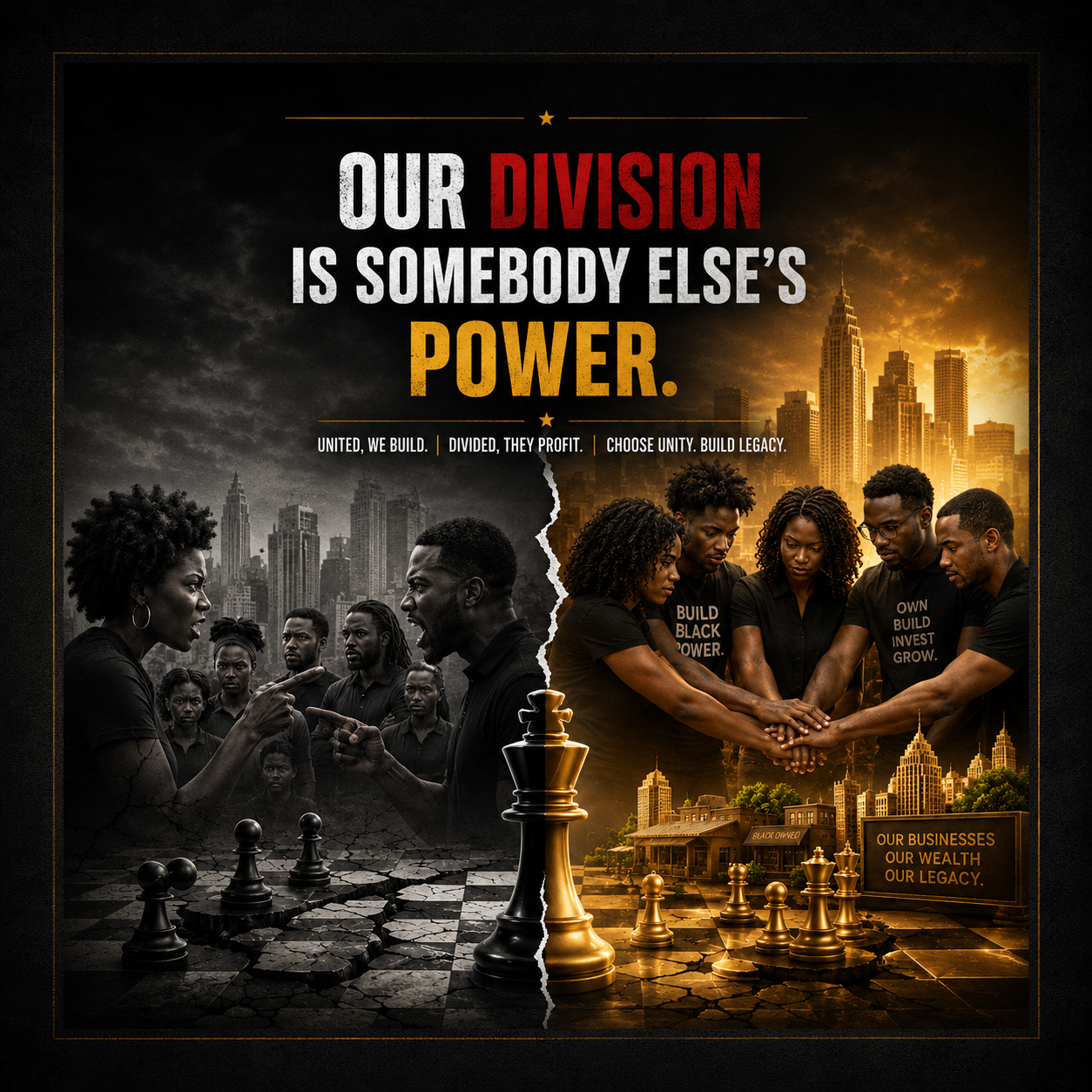
Our Division Is Somebody Else’s Power
How religion, sexuality, lineage, nationality, and inherited programming keep the African diaspora divided
There is something we need to understand about division.
Difference is natural. Division is not inevitable.
Human beings have always been different.
Different languages.
Different cultures.
Different spiritual practices.
Different customs.
Different families.
Different political ideas.
Different ways of loving.
Different ways of understanding life, death, creation, nature, and the unseen world.
Africa was never one giant culture where everybody thought alike.
Ancient African civilizations fought wars. They competed for resources. They formed alliances. They developed hierarchies. They disagreed. They conquered one another. They experienced political struggles just like every other human civilization.
So this is not an attempt to romanticize ancient Africa as some perfect place where conflict never existed.
The important question is something different:
When did difference become a reason to deny one another humanity?
When did difference become:
You are beneath me.
You do not belong.
Your beliefs make you evil.
Your sexuality makes you less worthy.
Your lineage makes you less Black.
Your nationality makes you my enemy.
Because once differences are organized into categories, something much larger has happened.
Difference has become hierarchy.
And hierarchy has always been useful to power.
Today, throughout the African diaspora, we repeatedly find ourselves divided around religion, spirituality, sexuality, nationality, ethnicity, lineage, class, immigration status, and cultural identity.
Christian versus spiritual.
Muslim versus Christian.
Religious versus nonreligious.
Heterosexual versus homosexual.
African versus African American.
FBA versus everybody else in the diaspora.
Caribbean versus African American.
Immigrant versus descendant.
One group constantly being told that another group represents the problem.
And in 2026, with access to more historical information than ordinary people have ever possessed, we have to start asking harder questions.
Where did these beliefs come from?
How old are they really?
Who turned differences into hierarchies?
And most importantly:
Who gains power when people of African descent spend their energy fighting one another?
Because whether we want to admit it or not, our division frequently becomes somebody else’s power.
Before the Labels
Long before what everyday people today would call organized religions became established across parts of Africa, African people already had spiritual systems of their own.
Our ancestors did not begin civilization waiting for someone to teach them how to understand spirituality.
They were already asking the questions human beings have asked since the beginning:
Who are we?
Where did we come from?
What happens when we die?
What is our relationship with nature?
What do we owe our ancestors?
What is sacred?
What is our responsibility to the community?
What exists beyond what we can physically see?
Different African peoples answered those questions differently.
There was no single “African religion.”
There were countless cosmologies, rituals, ancestral traditions, sacred practices, understandings of nature, deities, spirits, ceremonies, and philosophies.
Ancient Egypt gives us one example.
Egyptian spiritual life developed over thousands of years and included numerous deities, local traditions, creation accounts, rituals, and sacred institutions. Different traditions could exist alongside one another, and Egyptian gods could share characteristics or become associated with one another without requiring every competing idea to disappear. (The Metropolitan Museum of Art)
But Egypt was only one African civilization.
Travel south into Nubia and we find the powerful Kingdom of Kush.
Kush developed its own political traditions, architecture, art, leadership structures, and religious culture. Kushite spirituality incorporated influences from Egypt while continuing distinctly Nubian traditions. The indigenous lion-headed deity Apedemak, for example, existed alongside deities such as Amun, Isis, and Osiris in Kushite religious life. (Smarthistory)
That matters.
African civilizations could encounter outside ideas, absorb some, reject others, transform others, and continue maintaining traditions of their own.
Influence did not automatically require cultural surrender.
And religious or spiritual difference did not automatically mean:
One of us must disappear for the other to exist.
That is an important foundation for everything that comes next.
African Spirituality Did Not Begin With Christianity or Islam
This part of the chronology matters.
Christianity was not present at the beginning of African civilization.
Islam was not present at the beginning of African civilization.
The later religious identities that billions of people recognize today belong to later periods of human history.
African civilizations already existed.
African spiritual systems already existed.
African cosmologies already existed.
African people were already thinking about creation, morality, death, ancestors, nature, community, and the unseen world.
Then later religious systems entered different African societies.
Christianity eventually reached parts of the continent and was adopted in different ways.
One important example is the ancient African kingdom of Aksum, in the region of present-day Ethiopia and Eritrea.
Before its conversion, Aksum had its own pre-Christian religious traditions. King Ezana converted to Christianity during the fourth century. Archaeological evidence even shows the transition on Aksumite currency: earlier religious symbols were replaced by the Christian cross after Ezana’s conversion. Christianity was initially concentrated among Aksum’s royal elite before spreading more broadly. (The Metropolitan Museum of Art)
And political interests were involved.
The Metropolitan Museum of Art notes that Ezana’s conversion may have helped strengthen Aksum’s trading relationship with the Roman world and that Christianity offered the king another way of bringing together his kingdom’s different ethnic and linguistic populations. (The Metropolitan Museum of Art)
That does not mean Ezana could not also have genuinely believed in Christianity.
We cannot climb inside the private mind of a man who lived more than 1,600 years ago.
But we can recognize something human beings have seen repeatedly throughout history:
Religion and political power can exist together.
Rulers can believe.
And rulers can simultaneously understand that religious alliances create political, diplomatic, and economic opportunities.
Islam came later still, originating outside Africa in seventh-century Arabia before spreading into different African regions through migration, trade, scholarship, political relationships, settlement, conquest, and conversion.
In West Africa, for example, trans-Saharan trade helped carry Islamic influence southward. Muslim merchants interacted with African kingdoms, and over time some rulers and populations adopted Islam while older spiritual systems continued alongside it. The Metropolitan Museum notes that in the Mali world, rulers did not necessarily push gold producers to abandon traditional beliefs because gold production itself remained connected to indigenous practices. (The Metropolitan Museum of Art)
Again:
Layer upon layer.
African spirituality did not begin when Christianity arrived.
African spirituality did not begin when Islam arrived.
Those religions entered societies that already possessed spiritual histories of their own.
And that should make us willing to ask a question that makes some people uncomfortable:
What did our ancestors believe before the religion we practice today reached them?
That question is not an attack on Christianity.
It is not an attack on Islam.
It is not telling anyone what they should believe.
It is history.
And history should never be so frightening that we are forbidden from examining it.
When Belief Becomes Power
Religion becomes dangerous to community when belief stops being:
“This is what I believe.”
and becomes:
“Because you do not believe what I believe, you are beneath me.”
There is a difference.
You can be deeply Christian without dehumanizing somebody who practices African spirituality.
You can be Muslim without believing that another Black person must become Muslim before you can work together.
You can be spiritual without mocking Black people who sincerely practice Christianity.
You can be atheist without believing religious people are incapable of contributing to community.
The problem isn’t belief.
The problem is hierarchy.
The moment a religious identity becomes a permission slip to determine who deserves dignity, protection, opportunity, or belonging, religion has become something more than personal faith.
It has become a mechanism of social power.
History teaches us repeatedly that institutions understand this.
And colonial governments understood it extremely well.
Colonization Did Not Invent Every Difference. It Learned How to Use Them.
We have to remain historically honest.
European colonizers did not invent every African ethnic group.
They did not invent every rivalry.
They did not create every war.
Africans had political conflicts before Europeans arrived.
But colonial governments became extremely skilled at classifying, hardening, reorganizing, and politically exploiting differences that already existed.
Indirect colonial rule frequently assigned people to tribal or ethnic classifications, connected those classifications to chiefs and customary authority, and attached political and land rights to them. Modern research has found a relationship between indirect colonial rule and stronger political identification with ethnicity in parts of sub-Saharan Africa even generations later. (ScienceDirect)
Think about the mechanism.
First:
Name the groups.
Then:
Separate the groups.
Then:
Give different groups different access to authority.
Then:
Attach resources to those categories.
Then:
Make the categories politically important.
Then watch what happens.
People who may have previously experienced identity in more flexible ways now have political, economic, and social reasons to guard that identity.
Difference becomes competition.
Competition becomes resentment.
Resentment becomes hostility.
And hostility becomes incredibly useful to whoever controls the structure above them.
Name Them. Separate Them. Rank Them.
Rwanda provides one of history’s clearest warnings.
Hutu and Tutsi identities existed before European colonialism.
Europeans did not simply invent those names.
But Belgian colonial authorities hardened those identities and attached political privilege to them. Belgians favored the Tutsi minority in significant areas of colonial administration and eventually required Rwandans to carry identification cards officially classifying them by ethnicity. (United States Holocaust Memorial Museum)
Think about what happens when the government turns identity into paperwork.
You are no longer simply living beside someone whose ancestry or social position differs from yours.
Now the state has officially told you:
This is what you are.
This is what they are.
And these categories matter.
That is how identity becomes machinery.
Identify.
Separate.
Classify.
Rank.
Reward.
Exclude.
Repeat.
The consequences of Rwanda’s later history were far more complicated than colonial identity cards alone, and responsibility for the 1994 genocide belongs to the people and institutions that planned, promoted, and committed it.
But colonial racialization helped leave behind a political structure in which ethnic distinction had been deliberately hardened and tied to state power.
That’s the lesson.
You don’t always have to invent people’s differences to control them.
Sometimes you simply need to convince them that their differences matter more than everything they share.
Sexuality: Another Boundary We Were Taught to Police
Now let’s talk about homosexuality.
There is a common modern argument that homosexuality was simply imported into Africa.
That statement is historically indefensible as a blanket claim.
Africa is enormous.
Thousands of societies have existed across the continent over thousands of years.
Their attitudes toward sexuality were not identical.
What we can document very clearly is that European colonial governments imported criminal laws targeting same-sex sexual behavior into many territories.
British colonial officials spread versions of anti-sodomy legislation throughout much of their empire. Human Rights Watch traced laws criminalizing consensual same-sex conduct from British colonial legal codes into numerous territories in Africa and elsewhere. Colonial officials explicitly described these laws as a way of imposing European sexual morality upon colonized populations. (Human Rights Watch)
Read that again.
Colonizers were not saying:
“We arrived and discovered Africans already enforcing our Victorian sexual laws.”
They brought legal systems with them.
And some of those legal legacies survived independence.
That should force us to question what we casually call “traditional.”
Something being taught by your parents does not prove it is ancient.
Something being taught by your grandparents does not prove it predates colonialism.
Something being preached in Africa today does not automatically make it indigenous to Africa.
Tradition tells us that something has been passed down.
Tradition does not automatically tell us where it originated.
And regardless of anyone’s religious opinion about sexuality, another question remains:
Why should a heterosexual Black person and a homosexual Black person be incapable of building together?
Why can’t they create businesses together?
Protect communities together?
Support Black institutions together?
Fight discrimination together?
Educate children together?
Strengthen neighborhoods together?
A heterosexual person does not lose heterosexuality because a gay person is sitting at the same table.
A Christian does not stop being Christian because someone beside them practices another spiritual path.
Sameness is not required for solidarity.
The Diaspora Was Then Separated by History
Now zoom outward.
The African diaspora did not experience one history.
The transatlantic slave trade scattered African populations across the Americas.
European colonialism carved Africa into political territories.
Different European empires imposed different languages and institutions.
African descendants developed cultures throughout the Caribbean, North America, South America, Europe, and elsewhere.
Generations passed.
New cultures formed.
Different foods.
Different languages.
Different music.
Different religions.
Different political struggles.
Different relationships to Africa.
Different experiences with slavery.
Different experiences with colonization.
Different experiences with citizenship.
Different experiences with racism.
Those differences are real.
We should acknowledge them.
But acknowledging difference and creating enemies are two different things.
There is an enormous difference between saying:
“Our historical experiences are different.”
and saying:
“Therefore, your people are beneath mine.”
One is historical specificity.
The other is hierarchy.
FBA Versus the Rest of the Diaspora
This is one of the divisions we have to be mature enough to discuss.
Foundational Black Americans have a specific historical experience in the United States.
That matters.
The descendants of people enslaved in what became the United States experienced American chattel slavery, Reconstruction, racial terror, Jim Crow, segregation, redlining, exclusion from wealth-building opportunities, discriminatory government policies, and generations of systemic barriers whose effects did not magically disappear.
That history should not be erased.
And discussing lineage-specific reparations does not automatically equal diaspora hatred.
Specificity is not division.
But specificity becomes division when:
“Our history is different”
turns into:
“Our history makes us superior.”
Or:
“You are not part of my lineage, therefore I should hate you.”
And accountability has to travel both directions.
African immigrants should not mock African Americans.
Caribbean people should not dismiss African American history.
African Americans should not reduce an entire continent of more than a billion people to stereotypes.
Africans should not treat Black American culture as inferior.
African Americans should not treat recent Black immigrants as enemies simply because their ancestors experienced a different branch of history.
African.
African American.
FBA.
Haitian.
Jamaican.
Ghanaian.
Nigerian.
Trinidadian.
Brazilian.
Afro-Latino.
Afro-European.
We can acknowledge different histories without creating a ranking system for Blackness.
Different branches do not require different enemies.
Different Issue. Same Architecture.
Now look at what keeps happening.
Religion:
You don’t worship like me, so you don’t belong.
Sexuality:
You don’t love like me, so you don’t belong.
Lineage:
Your ancestors experienced a different branch of the diaspora, so you don’t belong.
Nationality:
You weren’t born where I was born, so you don’t belong.
Ethnicity:
Your people are different from mine, so you don’t belong.
Different issue.
Same architecture.
Us versus them.
And that’s where we need to stop arguing long enough to ask the question power never wants people asking:
Who Benefits?
Division is politically valuable.
Always has been.
If I can convince two struggling populations that the greatest danger they face is each other, neither population spends enough time examining me.
If I can convince people that homosexuality is the greatest threat to their community, maybe they don’t ask why their schools remain underfunded.
If I can convince religious groups that another spiritual belief is their greatest enemy, maybe they don’t ask who owns the land beneath their communities.
If I can convince African Americans that Africans are stealing everything from them while simultaneously convincing African immigrants that African Americans are lazy or dysfunctional, both groups can spend years attacking one another while somebody else owns the apartment building they both live in.
If I can convince poor people that another poor group is the reason they are struggling, they may never investigate the institutions controlling wages, housing, lending, healthcare, education, or political representation.
Division redirects anger.
Instead of looking upward at power, people look sideways at one another.
And political structures understand that.
Religious institutions can understand it.
Media companies understand it.
Influencers understand it.
Social-media algorithms certainly understand it.
Fear generates attention.
Outrage generates engagement.
Enemies generate loyalty.
And loyalty generates power.
The Most Successful Programming Does Not Need a Programmer
Here is where this gets even more uncomfortable.
At some point, the person who introduced a hierarchy no longer needs to be present.
The community begins maintaining it.
Parents teach children.
Religious leaders teach congregations.
Communities enforce social boundaries.
Friends police one another.
Influencers amplify division.
Algorithms reward outrage.
Children grow into adults who repeat something they have never researched.
Eventually someone asks:
“Why do you believe that?”
And the answer is:
“That’s how I was raised.”
But that only tells us where you received the belief.
It does not tell us where the belief originated.
Those are completely different questions.
The most effective programming is the programming we mistake for our own independent thought.
Nobody has to tell us whom to hate anymore.
We teach one another.
Nobody has to enforce the boundary.
We enforce it ourselves.
Nobody has to constantly maintain the hierarchy.
We protect it.
And that is one reason oppressive systems can survive long after the original political system that helped create or strengthen them is gone.
And Yes, Some of This Reinforces White Supremacy
This is where some people are going to get uncomfortable.
Good.
We need to understand what white supremacy actually means.
It is bigger than somebody wearing a hood or openly saying white people are superior.
Historically, white supremacy developed through systems that elevated European political authority, culture, racial classification, legal systems, economic interests, and social power over colonized and racialized populations.
Colonial rule frequently used classification, ethnic hierarchy, unequal investment, administrative boundaries, and indirect rule in ways that shaped political divisions long after colonial governments formally disappeared. (OUP Academic)
So if we continue reproducing hierarchies that were strengthened by those systems, we can reinforce their logic even when no white person is standing in the room telling us what to do.
That does not mean every disagreement among Black people was created by white supremacy.
That would be intellectually lazy.
It means something more important:
We can create some of our own disagreements while still handling those disagreements in ways that preserve somebody else’s hierarchy.
When we decide another Black person deserves less humanity because of sexuality, nationality, ethnicity, religious belief, or lineage, who gets stronger?
Not us.
When we spend years arguing about which branch of the diaspora is the “real” Black population while our communities struggle to build businesses, institutions, schools, political organizations, media, housing, food systems, and generational wealth, who gains from the distraction?
Not us.
When we are too divided to cooperate, somebody else maintains the economic and political advantage.
Our division becomes somebody else’s power.
Power Can Also Be Gained Inside the Community
We should not pretend every person promoting division is being unknowingly manipulated.
Some people benefit directly from it.
A religious leader can gain authority by constantly identifying sinners and outsiders.
A politician can gain votes by creating an enemy.
An influencer can build an enormous platform by keeping Black people furious at another Black population.
An organization can gain members by convincing people that everybody outside the organization is dangerous.
Someone can build social status by declaring who is “really Black.”
Another person can gain authority by claiming only their religion represents authentic African identity.
Another can build an audience around attacking LGBTQ Black people.
Another can monetize diaspora hostility every single day.
Division can create:
Money.
Followers.
Votes.
Clicks.
Status.
Donations.
Authority.
Power.
That means we should stop assuming that everyone telling us whom to hate is trying to liberate us.
Sometimes the conflict is the business model.
It Is 2026. We Have to Research What We Inherited.
There was a time when the average person could reasonably say:
“I didn’t know.”
Our ancestors did not have digital museum collections sitting in their pockets.
They didn’t have searchable historical archives.
They didn’t have university research databases.
They couldn’t compare archaeological evidence from Sudan with colonial legal documents from Britain while sitting at the kitchen table.
They couldn’t pull up ancient manuscripts, scholarly lectures, digitized newspapers, genetics research, museum collections, and historical records within seconds.
We can.
That does not mean everything on the internet is true.
It means we have unprecedented access to the tools required to investigate.
And that creates responsibility.
Before repeating something simply because our family taught it, ask:
Where did it originate?
How old is it?
What existed before it?
Who introduced it?
Who wrote the law?
Who controlled the institution?
Who translated the history?
Who gained authority from it?
What does archaeology show?
What do primary sources show?
What do historians disagree about?
What evidence exists beyond social media?
And perhaps the most important question:
Who benefits if I never investigate this?
Tradition deserves respect.
But:
Tradition explains why we inherited a belief. Tradition does not automatically prove that belief is true.
Our ancestors passed down extraordinary wisdom.
They also lived inside systems that programmed them.
Both things can be true.
Loving our ancestors does not require us to preserve every belief they inherited.
Sometimes honoring them means learning something they never had access to.
Unity Does Not Mean Uniformity
Let me make this very clear.
I am not calling for everybody across the diaspora to become spiritual.
I am not telling Christians to stop being Christian.
I am not telling Muslims to stop being Muslim.
I am not telling anyone to abandon religion.
I am not telling FBA descendants to stop talking about lineage.
I am not telling Africans to stop identifying with their nation or ethnic group.
I am not telling Caribbean people to abandon Caribbean culture.
I am not asking heterosexual people to become gay.
I am not asking gay people to justify their existence.
I am not asking everyone to vote alike.
Think alike.
Worship alike.
Speak alike.
Or experience Blackness the same way.
Unity does not require uniformity.
That may be one of the most important lessons we have to learn.
You don’t have to worship like me to build with me.
You don’t have to love like me to deserve my protection.
You don’t have to descend from exactly the same branch of history to share economic interests with me.
You don’t have to come from my country for me to recognize your humanity.
You do not need to become me.
And I do not need to become you.
We simply have to stop turning every difference into a weapon.
Imagine What Happens When We Stop Fighting Sideways
Imagine the energy currently spent fighting each other redirected toward building.
Christians building alongside spiritual people.
Muslims building alongside Christians.
Straight Black people protecting gay Black people from violence simply because they are human beings.
Africans and African Americans creating trade relationships.
Caribbean entrepreneurs doing business with Black American households.
FBA organizations pursuing lineage-specific policy goals without requiring hatred toward other members of the diaspora.
African nations strengthening relationships with diaspora communities.
Black professionals mentoring across nationality.
Families studying history instead of inheriting hostility.
Businesses collaborating.
Money circulating.
Knowledge moving.
Children learning multiple histories.
Communities protecting one another.
Nobody has to surrender identity.
Nobody has to pretend historical differences do not exist.
Nobody has to erase their culture.
We simply recognize:
Our differences do not have to become somebody else’s weapon.
The African diaspora is never going to become one culture.
We are too large.
Too geographically dispersed.
Too historically complex.
Too culturally rich.
That should not be viewed as a failure.
It may actually be one of our greatest advantages.
Different languages mean access to different markets.
Different nationalities mean global connections.
Different cultural traditions mean different knowledge.
Different histories mean different strategies.
Different skills mean different resources.
Different perspectives mean different solutions.
Diversity becomes weakness only when we are convinced that difference requires hostility.
Our Division Is Somebody Else’s Power
We do not have to believe alike to build together.
We do not have to worship alike to protect one another.
We do not have to love alike to recognize one another’s humanity.
We do not have to share identical histories to recognize overlapping interests.
We do not have to abandon our lineage to respect someone else’s.
And we do not have to erase our differences to recognize when those differences are being used against us.
The history is available.
The archaeological record is available.
The colonial documents are available.
The laws are available.
The scholarship is available.
The information our ancestors were denied is increasingly accessible to us.
So now we have another responsibility:
Unlearn what needs to be unlearned.
Research what needs to be researched.
Question what needs to be questioned.
Keep the traditions that strengthen us.
Release the programming that requires us to dehumanize one another.
And stop giving away collective power every time somebody hands us another reason to fight.
Because the danger was never simply that we were different.
We have always been different.
The danger is being convinced that those differences make cooperation impossible.
Every time we turn religion, sexuality, nationality, ethnicity, or lineage into permission to dehumanize another person of African descent, we weaken ourselves.
Every time we choose hierarchy over humanity, somebody benefits.
Every time we choose hostility over strategic cooperation, somebody benefits.
Every time we fight sideways instead of examining the systems above us, somebody benefits.
And far too often,
our division is somebody else’s power.