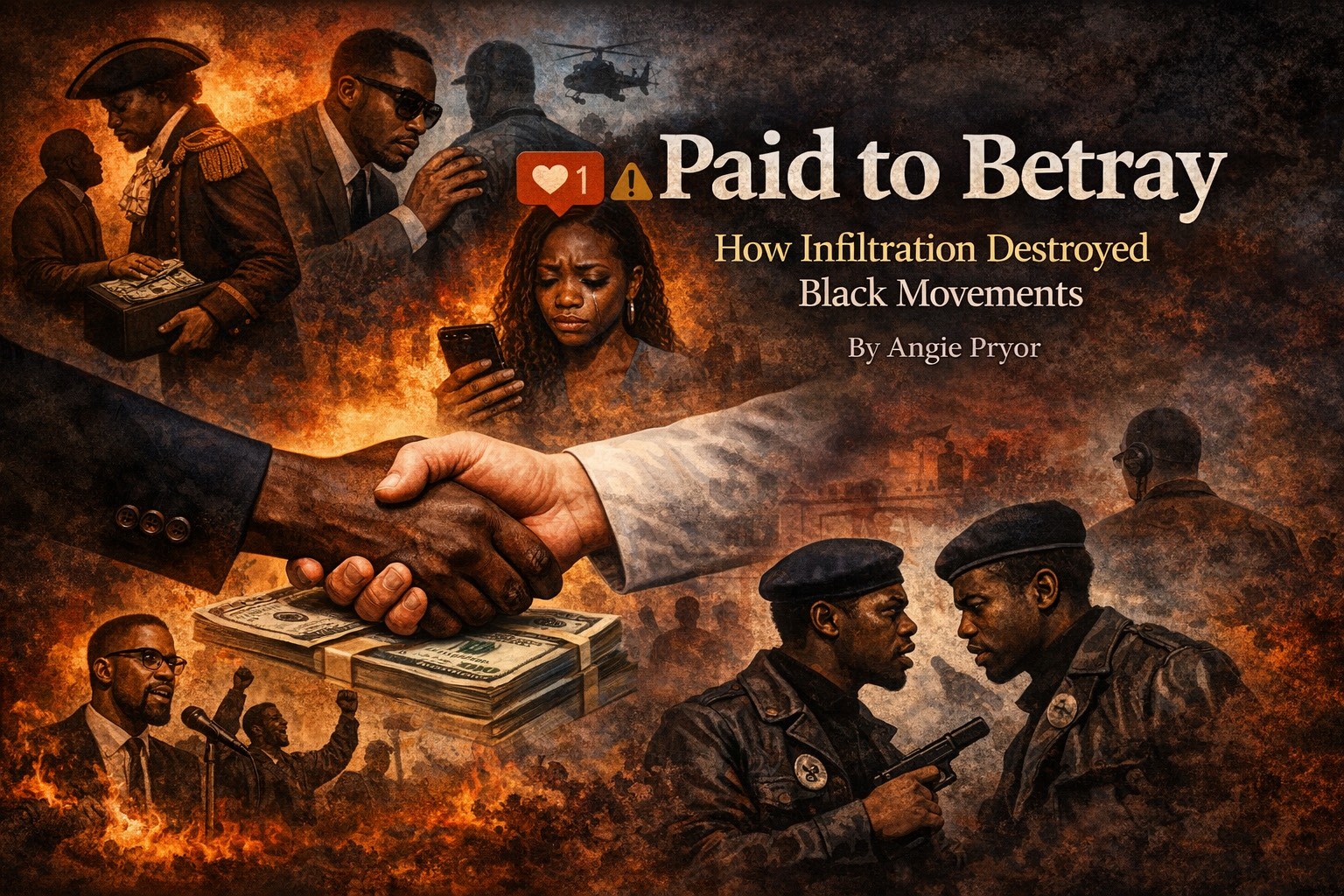
Paid to Betray: How Infiltration Destroyed Black Movements
There is a truth that many of us feel… but don’t always say out loud.
Across the entire African diaspora—from the continent, to the Caribbean, to the United States—our movements have always been studied, targeted, and disrupted. But one of the hardest truths to confront is this:
Some of our greatest setbacks didn’t come from our enemies.
They came from within. This is not a message rooted in blame. This is a message rooted in awareness. Because if we don’t understand the pattern, we will keep repeating it.
A Pattern Repeated Across History
When you begin to study our history—not just in one country, but globally—you start to notice something. Every time we moved toward unity, toward power, toward liberation… something fractured us from the inside. During slavery, division was not accidental. It was engineered. Systems were put in place to separate, reward, and control. Some were placed in positions where survival depended on enforcing rules over others who looked just like them. That wasn’t just oppression—it was conditioning.
In colonial Africa, European powers didn’t just invade with weapons. They negotiated, bribed, and manipulated leadership structures. Resources were signed away. Power was exchanged. Entire nations were impacted by decisions made under pressure, influence, or promise.
When Marcus Garvey built one of the largest global movements for Black unity, it didn’t just face resistance from the outside. There were fractures from within—misinformation, pressure, and internal breakdowns that weakened what had been built.
During the Civil Rights Movement and the rise of the Black Panther Party, infiltration became even more strategic. Informants, internal disruption, mistrust—these weren’t coincidences. These were calculated efforts that often relied on people who could blend in, who looked like the community they were sent into.
At some point, we have to stop seeing these as isolated incidents and start recognizing them for what they are:
A pattern.
Why This Keeps Happening
This is where the conversation shifts. Because this isn’t just about history. It’s about psychology. Generational trauma does not just disappear—it adapts. When people have been systemically oppressed for generations, survival becomes the priority. Not unity. Not long-term liberation. Survival and survival can look like compromise.
It can look like choosing proximity to power over responsibility to your people.
It can look like accepting money, access, or opportunity—even when it comes at a collective cost.
Some people didn’t betray their communities because they hated them.
Some did it because they didn’t believe we could ever truly win, and when you don’t believe freedom is possible, you start making decisions based on what feels immediately beneficial—even if it’s ultimately harmful.
Where We See It Today
If we’re honest, this didn’t end in the past.
It evolved.
The Entertainment Industry
Today, influence is one of the most powerful currencies in the world. And many of the most visible figures in our community hold that influence.
So we have to ask:
When public figures align themselves with systems, narratives, or political positions that are harmful to their own communities… what is that?
Is it influence?
Or is it alignment?
Because at some point, influence without responsibility becomes participation.
Profiting Off Destruction
We also see it in business. Liquor brands. Drug culture. Products that are marketed, promoted, and normalized—despite the well-documented impact they have on Black communities. Communities where liquor stores sit on nearly every corner.
Communities already struggling with addiction, trauma, and limited resources and yet, we see familiar faces—faces that come from those same communities—putting their names on the very things that contribute to the problem.
At some point, we have to say it plainly:
You know the damage and you still chose to profit from it.
That’s not just business.
That’s participation.
Social Media: The New Infiltration System
The most powerful—and most dangerous—form of infiltration today is happening right in our hands. On our phones.
Social media has become one of the most influential tools in modern history. It shapes perception. It controls visibility. It determines what gets amplified and what gets ignored.
And what does it reward?
Not healing.
Not unity.
Not growth.
It rewards engagement and the fastest way to get engagement is through conflict, trauma, and division. There are entire systems, agencies, and strategies built around this understanding. And they don’t always have to create the narratives themselves. They just have to incentivize us to create them.
We see it every day:
Black trauma turned into viral content.
Public humiliation framed as entertainment.
Division between Black men and women.
Arguments between Africans, African Americans, and Caribbeans about identity and experience.
The more divisive the content is… the more visible it becomes.
The more visible it becomes… the more profitable it becomes.
So now we have to ask a harder question:
Are we being used?
Or are we choosing to participate?
Because not everything is forced anymore.
Some of it… is chosen.
The Cost of This Pattern
The cost is not just individual—it’s collective.
Broken movements.
Distrust within our communities.
Cycles of rebuilding… only to collapse again.
When we cannot trust each other, we cannot build anything that lasts, and that may be one of the most effective strategies ever used against us.
The Truth We Avoid
There is a phrase that has circulated in our communities for generations:
“Not all skinfolk are kinfolk.”
While it may sound harsh, history has shown us that it carries truth.
Everyone who looks like you is not aligned with you.
Everyone who comes from your community is not committed to its growth, and that doesn’t make them enemies in a traditional sense—but it does mean we have to move with awareness.
The Path Forward
This is not about division.
It’s about clarity.
We acknowledge the trauma. We understand the conditioning, but we stop repeating the cycle. We become more intentional about what we support, what we promote, and what we participate in. We choose accountability over comfort. Awareness over ignorance and collective growth over individual gain at any cost. Because healing is not just about what was done to us. It’s about what we refuse to keep doing to each other.
Final Thought
At some point, we have to stop asking what was done to us…
and start asking what we’re willing to stop doing.
Because the system does not sustain itself on its own.
It requires participation.
And real power begins the moment we decide…
not to participate anymore.