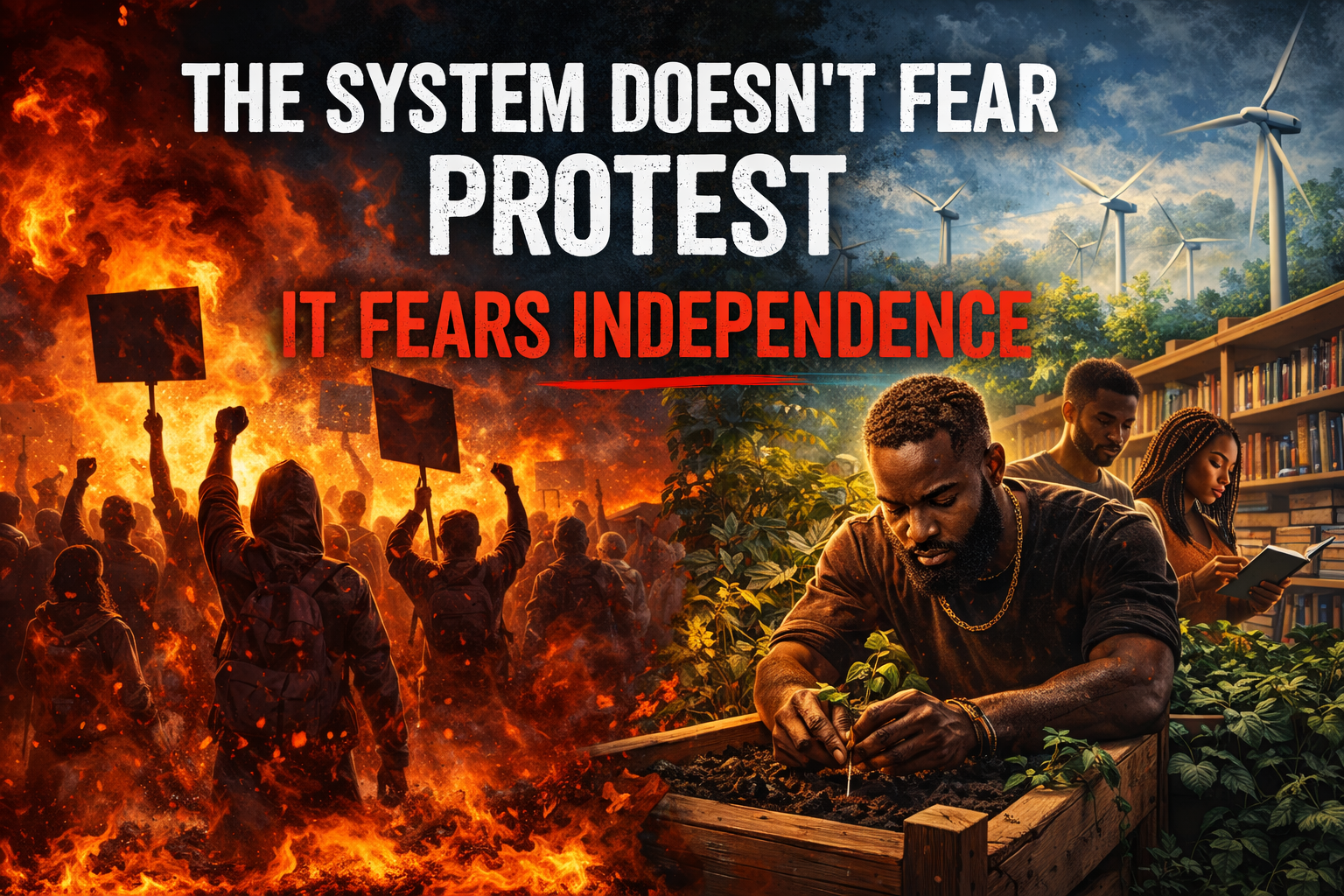
The System Doesn’t Fear Protest
It Fears Independence
For decades, protest has been presented as the primary tool of resistance. March. Chant. Organize demonstrations. Hold signs. These acts are often powerful expressions of frustration and unity. They can draw attention to injustice, mobilize communities, and force public conversations that might otherwise never happen, but there is a question that more people are beginning to ask.
If protest alone were enough to transform systems of power, why do the same problems keep returning generation after generation? Why do communities continue fighting the same battles every decade? The answer is uncomfortable but important. The system does not truly fear protest. What it fears is independence.
Protest Can Be Managed
Protest has existed for centuries. Governments, institutions, and powerful interests understand how it works. They know that protests usually follow a predictable pattern. An injustice occurs. Communities organize demonstrations. Media coverage increases. Public pressure rises. Eventually, statements are made, commissions are formed, and small reforms are introduced. Then the cycle resets. The system adapts because protest is something it can anticipate. Protests often take place in public spaces that authorities already control. Demonstrations happen within legal frameworks that institutions themselves created. In many cases, protests even become part of the political theater of democracy. Leaders respond. Cameras roll. Speeches are given, but the deeper structures of power often remain largely untouched.
The Type of Power Systems Actually Fear
What systems truly fear is not outrage. They fear self-sufficiency. History shows that the greatest shifts in power rarely occur because people protested alone. They occur when people build alternatives. When communities develop economic systems that no longer depend on external control. When they educate their children outside narratives designed to limit them. When they organize resources internally rather than exporting wealth outward. When they build networks strong enough that they cannot easily be destabilized. That is the kind of independence that forces institutions to respond differently. Because independence changes the balance of power.
Economic Independence Changes Everything
Economic independence has always been one of the most powerful forms of resistance. When communities control their own economic resources, they gain the ability to make decisions without asking permission. They can support their own businesses. They can fund their own schools. They can create employment opportunities within their own communities. They can circulate wealth internally instead of watching it leave their neighborhoods. That kind of economic structure creates stability that does not depend on political shifts, and that kind of stability reduces the ability of outside institutions to dictate the conditions under which communities live.
Information Is Power
Another form of independence comes from knowledge. When communities control their own narratives, research their own histories, and develop their own educational platforms, they gain intellectual independence. Knowledge allows people to understand how systems function. It reveals patterns that might otherwise remain hidden. It gives individuals the ability to question assumptions that have been repeated for generations. When people learn how systems operate, they become harder to manipulate and systems that depend on control do not like that.
Cultural Independence Matters Too
Cultural independence is another layer of power. Communities that maintain strong cultural identity often possess resilience that cannot easily be disrupted. Shared values, traditions, and collective memory provide a foundation that helps communities survive periods of instability. Culture is more than identity. It is infrastructure for survival. When culture is strong, people recognize themselves in one another. They cooperate more easily. They organize more effectively and when cooperation increases, collective strength increases as well.
Protest Without Infrastructure
Protest without infrastructure can express frustration, but it rarely creates lasting transformation. Infrastructure means systems. Economic systems. Educational systems. Communication networks. Community safety systems. Health systems. These structures determine whether a community can sustain itself. When infrastructure exists, protest becomes only one part of a much larger strategy. When infrastructure does not exist, protest becomes the entire strategy. That leaves communities vulnerable to cycles of temporary attention followed by long periods of neglect.
Protest Does Not Always Look Like the Streets
In recent months, a conversation has begun circulating online, particularly among Black Americans across different generations. Some members of Generation X and older generations have criticized younger Black voters — especially Black women — for saying they will no longer participate in traditional protest movements after the most recent election cycle.
The criticism often sounds like this:
“Our generation marched.”
“We protested.”
“We put our bodies on the line.”
There is truth in that history. Many previous generations did take extraordinary risks in the struggle for civil rights. Their courage created opportunities that later generations have benefited from, but history also teaches another lesson. Every generation develops its own strategy for survival. What worked in 1965 does not necessarily look the same in 2026, and that does not mean the commitment to justice has disappeared.It means the methods are evolving.
The Real Shift
The most powerful shift a community can make is moving from reacting to systems toward building systems of its own. Reaction keeps communities locked into responding to decisions made elsewhere. Creation moves communities into a different position. Instead of waiting for institutions to change, communities begin shaping their own environments. Instead of reacting to policies, they create structures that operate regardless of policies. Instead of depending entirely on outside systems, they strengthen their own. That shift changes everything.
Why This Matters Now
We live in an era where information travels faster than ever before. Communities across the diaspora are communicating, organizing, and sharing knowledge in ways that were not possible even a generation ago. Technology has opened new doors for education, collaboration, and economic cooperation, but those opportunities require a change in mindset. Moving from protest-centered thinking to independence-centered thinking requires discipline, patience, and long-term planning. It requires communities to invest in institutions that may take years to fully develop. It requires people to think beyond immediate emotional reactions and focus on generational impact. That work is harder than protest, but it is also far more powerful.
The Question We Must Ask
If communities placed as much energy into building independent systems as they place into protesting broken ones, what could change?
What could happen if the focus shifted from demanding solutions to creating them?
What would our communities look like if independence became the primary goal? These questions do not dismiss the importance of protest. They simply recognize that protest alone cannot sustain a community. Only systems can do that.
Final Thought
Protest can draw attention, but independence creates power. The systems that shape our world do not fear signs, chants, or marches nearly as much as they fear communities that no longer depend on them. You can place this after the section titled “Protest Without Infrastructure.”
Protest Is Not One-Dimensional
For decades, the dominant image of protest has been people marching in the streets, but protest can take many forms. Protest can look like economic boycotts. Protest can look like building independent institutions. Protest can look like withdrawing labor, attention, and participation from systems that exploit communities. Protest can look like redirecting energy toward community infrastructure rather than political spectacle. In other words, protest does not always have to involve putting one’s body in danger. Communities can choose strategies that protect their people while still challenging systems of power.
Strategic Withdrawal Is Also Protest
Sometimes the most powerful act is not confrontation. Sometimes it is withdrawal. When individuals or communities decide to redirect their energy away from systems that repeatedly fail them, that decision sends a message.
It says:
We will no longer invest all of our energy into structures that refuse to change. Instead, we will invest in ourselves. That kind of strategic withdrawal can be uncomfortable for those who are used to seeing activism expressed through public demonstrations, but it is still a form of resistance. In many cases, it is a safer and more sustainable one.
Protecting Our People Matters
Another reality that many people are beginning to acknowledge is that traditional protest has often placed Black bodies directly in harm’s way. History is filled with examples where peaceful demonstrators were met with violence, surveillance, arrests, or long-term retaliation. While those sacrifices were real and significant, it is also reasonable for new generations to ask an important question: Must protest always require physical risk? In an era of advanced surveillance, political polarization, and rapidly escalating public tensions, communities have every right to explore forms of resistance that prioritize safety. Protecting the well-being of Black women, Black men, and Black families is not weakness. It is strategy.
The Evolution of Resistance
Resistance has always evolved. Earlier generations used marches, boycotts, legal challenges, and grassroots organizing. Today’s generation has additional tools available: Digital organizing. Independent media platforms. Economic networks. Educational communities. Decentralized information sharing. These tools allow people to challenge systems of power in ways that do not always require physical confrontation. That evolution should not be dismissed. It should be understood.
The Bigger Picture
The real goal has never been protest for the sake of protest. The goal has always been freedom, stability, and long-term survival. If new strategies allow communities to move closer to those goals while reducing unnecessary harm, then those strategies deserve serious consideration. The future of any community depends not only on courage — but also on wisdom, and wisdom often means knowing when to confront a system directly and when to build something stronger outside of it.