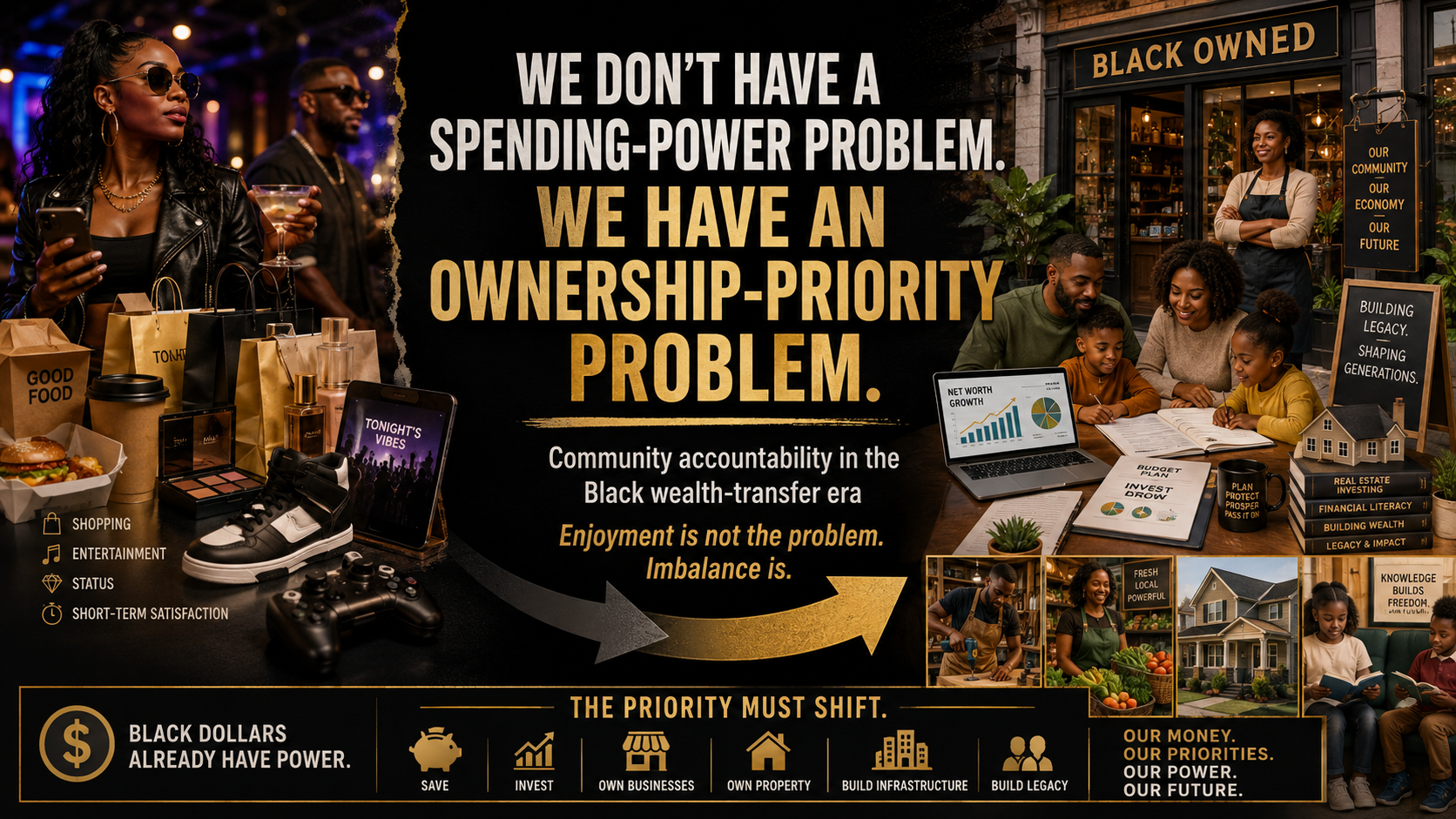
We Don’t Have a Spending-Power Problem. We Have an Ownership-Priority Problem
Community Accountability in the Black Wealth-Transfer Era
There comes a point in every movement when the mirror has to turn inward.
We know what has been done to Black people in America.
We know about slavery.
We know about stolen labor.
We know about Jim Crow.
We know about redlining.
We know about discriminatory lending.
We know about Black farmers losing land.
We know about neighborhoods intentionally denied investment.
We know about employment discrimination.
We know about unequal access to capital.
We know about the racial wealth gap.
We know systemic racism exists.
We know reparations are a legitimate conversation.
None of that disappears simply because we decide to hold ourselves accountable.
Two things can be true at the same time.
Systems have economically oppressed us, and we have not always made the best decisions with the money we did control.
Those truths do not cancel each other out.
In fact, if we are serious about a Black wealth transfer, we have reached the point where both truths have to be discussed at the same time.
Black Americans have enormous economic influence. Nielsen reports Black buying power at approximately $2.1 trillion, reflecting the tremendous amount of income available throughout Black America for spending and saving. (Nielsen)
That does not mean Black Americans literally spend $2.1 trillion every year.
It does mean something important:
Money is moving through Black hands.
The question is what we are doing with it.
The Excuses Cannot End the Conversation Anymore
Every time community financial accountability comes up, the conversation seems to follow the same script.
Someone says Black households should save more.
Someone responds with the racial wealth gap.
Someone says we need more Black businesses.
Someone responds with discriminatory lending.
Someone says we need to invest.
Someone responds with lower wages.
Someone says we should redirect more money toward Black-owned businesses.
Someone responds by explaining everything America has done to prevent Black wealth.
Those facts are real.
They still do not answer the question.
What are we doing with the dollars we actually control?
Systemic racism did not prevent us from buying shoes.
Redlining did not prevent us from going to restaurants.
Discriminatory lending did not prevent us from buying clothes.
The racial wealth gap did not prevent us from spending on entertainment.
Economic inequality did not stop Black dollars from flowing into beauty, alcohol, fashion, technology, nightlife, subscriptions, vacations, and countless other consumer industries.
We somehow found the money to consume.
That means we have to be willing to examine what we prioritized.
This is not about pretending everyone has the same income.
They do not.
This is not about pretending poverty is merely the result of bad budgeting.
It is not.
This is not about telling someone struggling to pay rent that the reason they do not own a house is because they bought coffee.
That kind of financial advice is ridiculous.
This conversation is about something much larger:
As a community, what have we trained ourselves to prioritize whenever discretionary money is available?
The Numbers Tell Us Something
The Bureau of Labor Statistics Consumer Expenditure Survey reported that Black consumer units averaged approximately $58,100 in total annual expenditures in 2024. (FRED)
Within that spending, the average Black consumer unit spent:
- $2,448 on food away from home
- $1,804 on apparel and services
- $520 on footwear alone
- $928 on personal-care products and services
- $655 on education
- $288 on tobacco products and smoking supplies (FRED)
Those numbers are averages, not descriptions of every Black household.
They still tell us something.
We know how to spend consistently.
We budget for what matters to us.
We find money for what matters to us.
We plan for what matters to us.
We sacrifice for what matters to us.
The wealth-transfer conversation requires us to ask whether ownership matters enough yet.
We Have Mastered Consumerism
Black culture has extraordinary influence.
We influence fashion.
We influence music.
We influence beauty.
We influence language.
We influence sports culture.
We influence entertainment.
We influence sneaker culture.
We influence hairstyles.
We influence nightlife.
We influence what becomes cool.
Corporations know this.
Marketing departments know this.
Brands know this.
Influencers know this.
The world watches Black culture, identifies what we make valuable, and figures out how to monetize it.
Air Jordans did not become culturally iconic in a vacuum.
Sneaker culture did not become what it is without Black athletes, hip-hop, Black youth culture, fashion, music, and community influence.
The same pattern can be seen across countless industries.
We have proven repeatedly that Black culture can create demand.
Here is the uncomfortable question:
Why have we been so good at creating demand and so much less intentional about owning the infrastructure that supplies that demand?
That is where accountability begins.
Beauty Is One of the Clearest Examples
Look at beauty.
NIQ reported in March 2026 that Black consumers spent approximately $16.2 billion on beauty and personal-care products during the preceding year, accounting for 12.8% of beauty dollar sales. (NIQ)
Sixteen point two billion dollars.
Think about the ecosystem surrounding Black beauty.
Hair products.
Braiding hair.
Extensions.
Wigs.
Natural-hair products.
Conditioners.
Oils.
Edge control.
Loc products.
Cosmetics.
Skin care.
Fragrance.
Nails.
Salon services.
Beauty supplies.
For decades, enormous amounts of Black money have flowed into these industries while Black ownership of major pieces of the retail, distribution, manufacturing, warehousing, and supply-chain infrastructure remained far smaller than our consumer presence.
Somebody recognized the demand.
Somebody opened the store.
Somebody created the distribution network.
Somebody established relationships with manufacturers.
Somebody bought warehouses.
Somebody imported the products.
Somebody reinvested profits.
Somebody expanded.
Somebody built infrastructure.
Too often, we remained primarily the customer.
That is the part we have to own.
The question is not why somebody else recognized an opportunity.
The question is:
Why didn’t enough of us recognize that our own demand was the opportunity?
Our goal should not simply be owning the salon.
We should be thinking bigger.
Own the salon.
Own the building.
Own the beauty-supply store.
Own the product.
Own the formulation.
Own the patent or trademark.
Own the distribution company.
Own the warehouse.
Own the manufacturing operation.
Own the transportation company delivering the inventory.
Own the technology processing the sale.
That is an ecosystem.
That is what turning consumer power into ownership power looks like.
Stop Treating Consumption Like a Necessity and Ownership Like a Luxury
This is where priorities become visible.
Someone can spend $250 on sneakers and say:
“I don’t have enough money to invest.”
Someone can spend $100 going out and say:
“Saving $10 won’t make a difference.”
Someone can consistently spend money on appearance while saying:
“I can’t afford to start building anything.”
Someone can pay multiple monthly subscriptions automatically, yet investing $20 automatically somehow feels unrealistic.
Someone can plan months ahead for a vacation, yet never make a plan for ownership.
Not every person does these things.
Not every household has discretionary money.
Still, when the pattern exists, we should be adult enough to name it.
Sometimes the problem is income.
Sometimes the problem is the system.
Sometimes the problem is an emergency.
Sometimes the problem is an unexpected expense.
Sometimes the problem is priorities.
Multiple things can be true at once.
“So Black People Aren’t Supposed to Have Fun?”
This argument comes up every single time.
“Are Black people not supposed to enjoy themselves?”
“Are we not allowed to have nice things?”
“Why are Black people always being told to sacrifice?”
That is an extreme response to an argument nobody made.
Nobody is saying Black people cannot have fun.
Go to the concert.
Take the vacation.
Buy the outfit.
Wear the shoes.
Go to dinner.
Celebrate your birthday.
Get your hair done.
Enjoy entertainment.
Buy something simply because you like it.
Black people deserve joy.
Black people deserve rest.
Black people deserve beautiful things.
Black people deserve experiences.
Black people deserve pleasure.
Black people also deserve ownership.
Two things can be true.
Three things can be true.
Five things can be true.
We can enjoy ourselves and save.
We can dress well and invest.
We can travel and build emergency reserves.
We can buy shoes and own assets.
We can enjoy entertainment and own intellectual property.
We can go to restaurants and deliberately patronize Black-owned restaurants.
We can spend money on our hair and intentionally seek Black-owned manufacturers, salons, stores, and distributors.
The problem has never been enjoyment.
The problem is imbalance.
Something is wrong when consumption receives all of our enthusiasm, planning, persistence, creativity, and discipline while ownership receives whatever is left.
Think about how determined we become when we really want something.
A shoe drops Friday?
We remember Friday.
Concert tickets go on sale at 10:00?
Somebody is online at 9:59.
Vacation is six months away?
We make payments.
Hair appointment before an event?
The appointment is scheduled.
New phone coming out?
We know the release date.
Imagine bringing that same energy to ownership.
Imagine checking the investment account with the same excitement.
Imagine automatically transferring money into savings with the same consistency as a streaming subscription.
Imagine families getting excited about launching a business.
Imagine children hearing conversations about stocks, property, intellectual property, manufacturing, and entrepreneurship as normally as they hear conversations about shoes and entertainment.
That is the balance we are talking about.
There has to be just as much priority and persistence behind becoming owners as there is behind being consumers.
The percentage will look different for every household.
One family may begin with 5%.
Another may begin with 10%.
Another may be able to redirect 20%.
The number is not the principle.
The principle is that ownership can no longer be an afterthought.
Reparations and Accountability Belong in the Same Conversation
Reparations are about what was taken.
Community accountability is about what we do with what reaches our hands now.
Those are separate questions.
They are also connected.
Reparations address slavery, dispossession, discriminatory government policy, exclusion from wealth-building opportunities, and economic harms that were deliberately imposed on Black Americans.
Nothing about this blog changes that.
Here is what also needs to be understood:
Receiving capital does not automatically create wealth.
Imagine receiving reparative capital while maintaining exactly the same economic behavior.
Where does the money eventually go?
Out.
Into somebody else’s corporations.
Somebody else’s businesses.
Somebody else’s property.
Somebody else’s investment portfolio.
Somebody else’s family wealth.
Somebody else’s infrastructure.
The money changes hands, then the same economic structure remains.
That is why:
Reparations can restore capital. Reparations cannot replace financial strategy.
We should demand what is owed.
We should also prepare ourselves to keep, invest, multiply, and strategically circulate whatever resources we receive.
Those ideas are not enemies.
They belong together.
We Cannot Build Black Infrastructure With Leftovers
This may be one of our biggest problems.
Everybody else gets paid first.
The shoe company gets paid.
The restaurant gets paid.
The beauty company gets paid.
The entertainment platform gets paid.
The liquor company gets paid.
The technology company gets paid.
The major retailer gets paid.
The delivery service gets paid.
The subscription gets paid.
Every company that has figured out how to market to us gets its money.
Then somebody says:
“Support Black business.”
Suddenly we are evaluating every penny.
Suddenly the price has to be perfect.
Suddenly the customer service has to be flawless.
Suddenly the business has one opportunity to make a mistake.
Suddenly we are asking whether supporting Black businesses even matters.
Black infrastructure cannot be built from leftovers.
A Black-owned business does not grow because we repost it.
A Black farmer does not survive because we tell everyone agriculture is important.
A Black author cannot build intellectual-property wealth if everybody expects the book for free.
A Black-owned media platform cannot survive on encouragement.
A Black manufacturer cannot buy equipment with likes.
A Black business cannot hire employees using hashtags.
Businesses need customers.
Businesses need repeat customers.
Businesses need capital.
Businesses need investment.
Businesses need patience while they scale.
Businesses need communities that understand that economic support is infrastructure building.
Supporting Black enterprise cannot simply be charity.
It has to become strategy.
The Wealth Transfer Requires a Consumer Transfer
If we are serious about transferring Black wealth, we have to redirect Black consumption.
Not all of it.
Not overnight.
Not through guilt.
Through intention.
Start somewhere.
Choose 5%.
Choose 10%.
Choose a category.
Maybe your household deliberately chooses more Black-owned restaurants.
Maybe beauty products become the first category you redirect.
Maybe you find a Black accountant.
A Black attorney.
A Black contractor.
A Black farmer.
A Black clothing company.
A Black-owned media platform.
A Black author.
A Black consultant.
A Black technology business.
A Black-owned service provider.
Maybe part of the money does not get spent at all.
It gets invested.
Saved.
Used to start a business.
Used to purchase equipment.
Used to create intellectual property.
Placed into a child’s investment account.
Put toward property.
Used for certification or education that increases earning potential.
Now the wealth transfer becomes something real.
It stops being just a slogan.
Stop Waiting for Extra Money
Another excuse has to go:
“When I make more, then I’ll start.”
More income does not automatically create financial discipline.
Sometimes more income simply creates more expensive consumption.
The practice has to begin with what we have.
Five dollars matters.
Ten dollars matters.
Twenty dollars matters.
One redirected purchase matters.
One investment matters.
One new Black-owned business added to the household purchasing routine matters.
One digital product created matters.
One child taught the difference between an asset and a liability matters.
We do not need everybody to become wealthy tomorrow.
We need millions of households practicing ownership today.
Small Money Is Still Money
We have a strange relationship with small amounts.
When spending:
“It’s only $20.”
When saving:
“What is $20 really going to do?”
Read that again.
Twenty dollars is meaningful enough to spend without thinking, yet somehow too insignificant to invest.
That logic has to change.
Corporations understand small-dollar economics perfectly.
Netflix does not need one customer paying billions of dollars.
It needs millions paying a smaller amount repeatedly.
Nike does not need one customer buying every pair of shoes.
It needs millions buying one pair.
Restaurants survive through repeated transactions.
Retailers grow through repeated transactions.
Banks accumulate deposits through repeated transactions.
Collective economics already works.
We participate in it every day.
The question is who receives the benefit.
If one million Black households redirected $100 per month, that would represent:
$100 million every month.
$1.2 billion every year.
Not new money.
Money already moving.
Now imagine what that money could help capitalize.
Businesses.
Property.
Investment portfolios.
Black agriculture.
Manufacturing.
Technology.
Schools.
Media.
Intellectual property.
Community institutions.
That is why nobody gets to tell me small amounts do not matter.
Scale makes small money powerful.
From Products to Assets
The next level of this wealth transfer requires us to think differently.
Buy the sneakers if you want them.
Own investments too.
Watch the movie.
Own intellectual property too.
Get your hair done.
Build ownership in the beauty economy too.
Enjoy the restaurant.
Consider owning food businesses, farmland, distribution, or restaurant property too.
Listen to music.
Support Black-owned labels, artists, publishing rights, and production companies too.
Use technology.
Build technology too.
Rent when you need to rent.
Learn how property ownership works too.
Consume.
Produce too.
That one word changes everything.
Community Accountability Is Not Community Shame
Accountability and shame are not the same thing.
Shame says:
“Black people are the problem.”
That is not what I am saying.
Accountability says:
“Black people have power, and we need to become more intentional about how we use it.”
That is completely different.
We did not create slavery.
We did not create redlining.
We did not create white supremacy.
We did not create discriminatory lending.
We did not create every economic obstacle placed in our path.
Those things were done to us.
Our response belongs to us.
There is tremendous power in that distinction.
If everything that happens to us is always entirely somebody else’s responsibility, then somebody else must always rescue us.
I refuse to believe that about Black people.
We have agency.
We have intelligence.
We have creativity.
We have labor.
We have businesses.
We have culture.
We have ideas.
We have buying power.
We have intellectual property.
We have millions of households.
We have global influence.
We have everything required to begin organizing ourselves differently.
Accountability is not punishment.
Accountability is power because it identifies what we can change.
Imagine Redirecting Just 10%
Imagine millions of Black households becoming intentional about only a fraction of discretionary spending.
Ten percent.
Not every dollar.
Not all enjoyment.
Not deprivation.
Balance.
Ten percent toward Black-owned businesses.
Ten percent toward investing.
Ten percent toward property.
Ten percent toward intellectual property.
Ten percent toward Black agriculture.
Ten percent toward manufacturing.
Ten percent toward children’s financial futures.
Ten percent toward businesses capable of employing people in our communities.
The exact categories would differ from household to household.
The mentality would be the same:
A portion of what leaves this household must build something.
Now imagine children growing up believing that is normal.
Imagine them watching their parents invest.
Imagine them watching a family business grow.
Imagine them understanding ownership before adulthood.
Imagine Black entrepreneurs launching companies into a marketplace where millions of Black households have already decided to intentionally support ownership.
Imagine Black businesses no longer trying to survive entirely on the hope that somebody happens to discover them.
Imagine manufacturers knowing a market exists.
Imagine Black farmers having predictable customers.
Imagine Black technology companies having users.
Imagine Black media having subscribers.
Imagine Black intellectual property being purchased instead of expected for free.
Imagine capital circulating long enough to become infrastructure.
That is a wealth transfer.
We Have Already Proven Our Dollars Can Build Empires
Black money works.
There has never been anything defective about the dollar once it reaches our hands.
It goes wherever we send it.
Our spending has helped support enormous industries.
Our culture has helped make brands culturally powerful.
Our tastes have influenced global trends.
Our creativity has generated extraordinary economic value.
The evidence that Black people possess economic influence is everywhere.
The question now is whether we are prepared to organize that influence.
We should fight systemic racism.
We should fight discriminatory lending.
We should fight housing discrimination.
We should challenge institutions.
We should demand reparations.
We should demand access to capital.
We should challenge laws and policies that continue creating unequal outcomes.
Then we should go home and have another conversation.
What are we doing with our money?
What are we buying?
What are we owning?
What are we investing?
What are we building?
What are we teaching our children?
Where does our dollar go after it leaves our hand?
Who does that dollar employ?
Whose property does that dollar pay for?
Whose company does that dollar grow?
Whose children eventually inherit the wealth created by that transaction?
Those are wealth-transfer questions too.
Enjoy your life.
Buy something you love.
Take the trip.
Go to dinner.
Celebrate.
Rest.
Have fun.
Dress beautifully.
Black liberation should never require Black misery.
Just build something too.
Save something too.
Own something too.
Invest something too.
Create something too.
Redirect something too.
Teach something too.
There has to be balance.
There has to be the same persistence behind ownership that we have demonstrated behind consumption.
Black Americans do not have a spending-power problem.
We have already demonstrated what our dollars can do.
The defining question of this wealth-transfer era is whether we finally decide that our own infrastructure deserves the same loyalty, discipline, enthusiasm, and persistence that we have given everybody else’s products.
Our dollars have already proven they can help build empires.
It is time for more of those empires to belong to us.
We don’t have a spending-power problem.
We have an ownership-priority problem.
Priorities can change.
Now let’s change them.