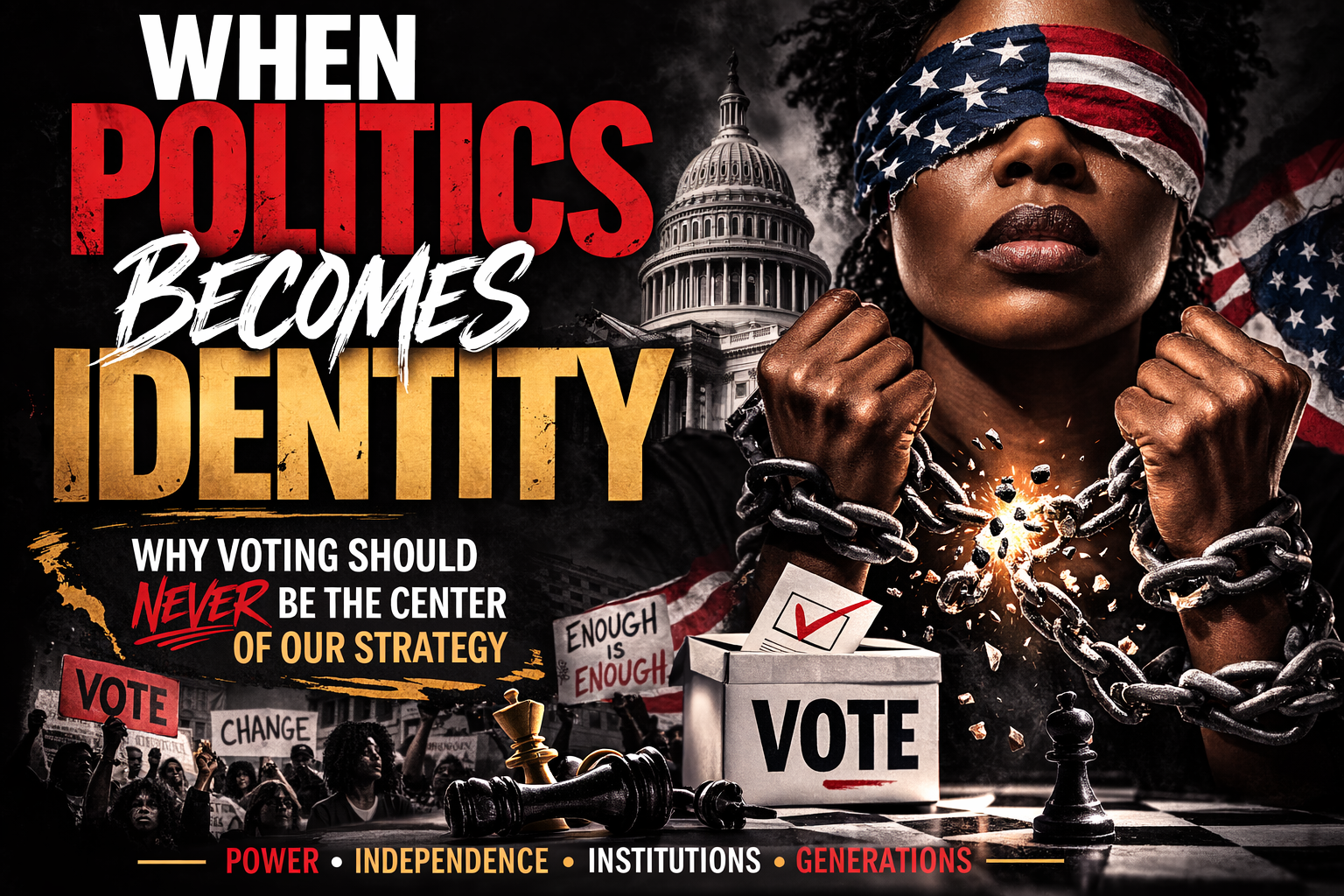
When Politics Becomes Identity
Why Voting Should Never Be the Center of Our Strategy
Across the United States, politics has become more than civic participation. For many people, it has become identity. Conversations revolve around it. Social media feeds are dominated by it. Friendships, families, and entire communities divide themselves along political lines. For many Americans, political loyalty now functions almost like religion, but for Black communities in America, the relationship with politics carries an additional layer of complexity.
For generations, voting has been framed as both a moral responsibility and a symbol of progress. The right to vote was fought for through extraordinary sacrifice. People marched, bled, and died for it. That history deserves respect, but somewhere along the way, something subtle happened. Voting stopped being viewed as one tool among many, and instead became the central strategy for survival, and that shift deserves serious examination.
Voting Is a Tool — Not a Strategy
Participating in elections is part of civic life. It can influence policy, leadership, and legislation. But voting alone has never been the primary source of power for any community. Communities gain power through institutions. Through economic networks. Through education systems. Through land ownership. Through cultural cohesion. Through community protection structures. Those forms of power exist regardless of who sits in office.
History shows us that communities that survive political instability do so because they built internal systems of support, not because they placed all their hope in national elections. Politics changes every few years. Institutions endure for generations. Yet in many conversations today, politics dominates the discussion while the work of building institutions receives far less attention.
The Illusion of Political Salvation
Every election cycle brings the same emotional urgency. This election will change everything. This candidate will fix the problem. This party represents the future.
The message is always framed in dramatic terms because drama mobilizes voters, but if we look at the long arc of history, one uncomfortable reality becomes clear: No political party has ever solved the fundamental challenges facing marginalized communities.
Policies may shift. Laws may evolve. Representation may increase. But structural realities often remain surprisingly consistent. Economic disparities persist. Educational inequality persists. Health disparities persist. If voting alone were the primary path to transformation, those patterns would look very different today. This does not mean political participation is meaningless. It means political participation is insufficient by itself.
A Real Example of Political Gridlock
If anyone doubts how political polarization can stall meaningful progress, we can look at a clear example from the early 2010s. In October 2010, Senate Republican leader Mitch McConnell publicly stated that “the single most important thing we want to achieve is for President Obama to be a one-term president.” This statement revealed something that many Americans already suspected: political strategy in Washington is often driven less by solving problems and more by defeating political opponents.
When Congress becomes deeply polarized, legislation can stall for years. One of the main tools used to block legislation in the U.S. Senate is the filibuster, which allows a minority of senators to delay or prevent a vote on a bill unless 60 senators agree to move forward. During President Obama’s administration, this tactic was used repeatedly as part of broader political battles. One example was the American Jobs Act, proposed in 2011 during the aftermath of the Great Recession.
The bill included measures that aimed to:
• create infrastructure jobs
• provide tax relief for workers and small businesses
• invest in schools and public facilities
• extend unemployment support
When the bill came to the Senate floor in October 2011, it failed to receive the 60 votes required to advance, effectively blocking the legislation from moving forward. This is what political gridlock looks like in practice. Bills that could impact employment, education funding, and economic recovery can sit in Congress indefinitely when the two parties refuse to cooperate. When that happens, the communities most affected by unemployment, underfunded schools, and economic instability often feel the consequences first. Political stalemates like this illustrate why relying exclusively on national politics can leave communities vulnerable.
If progress depends entirely on cooperation between polarized political parties, then progress can stall whenever political incentives change, and that is exactly why building strong community institutions, economic networks, and systems of mutual support matters so much. Because when national politics reaches a standstill, communities still need ways to survive, organize, and move forward.
This example strengthens your point because it shows:
• a real quote
• a real political tactic (filibuster)
• a real bill that stalled
• how polarization directly affects communities
And it supports your core argument without sounding partisan — it simply shows how the system functions.
When Politics Becomes Identity
The deeper concern is what happens when political engagement becomes the core identity of a community. When political identity dominates everything else, other priorities begin to fade. Discussions about economic independence become secondary. Conversations about land ownership become rare. Community discipline, family structure, and cultural development receive less attention. Instead, the focus shifts almost entirely toward reacting to national political drama. The result is a cycle where communities remain emotionally invested in systems that they do not control. Politics becomes a constant source of anxiety, outrage, and hope, while the long-term work of building independent structures remains unfinished.
In this environment, people begin to believe that survival depends entirely on decisions made in Washington, but communities that truly thrive do not depend on distant institutions for their daily survival. They build systems that sustain themselves.
Power vs Participation
Voting is participation. Power is something different. Power means controlling resources. Power means educating your own children. Power means protecting your own communities. Power means having economic networks that circulate wealth internally rather than exporting it elsewhere. Power means building structures that can endure regardless of which political party holds office. When communities lack these forms of power, elections begin to feel existential. Every political shift feels like a threat to survival, but when communities build strong internal systems, political outcomes become less destabilizing.They still matter. They simply do not determine everything.
The Real Question
The real question is not whether people should vote.
The real question is this:
What would our communities look like if we placed as much energy into building internal power as we place into political debate?
What if the same passion that fuels election conversations was directed toward economic cooperation?
What if the same urgency that drives voter mobilization was directed toward building institutions that serve future generations?
What if communities measured success not only by election results, but by how well they could sustain themselves regardless of who holds office?
These are not anti-political questions. They are pro-community questions.
Independence Changes the Equation
When communities become capable of sustaining themselves, the entire relationship with politics changes. Political engagement becomes strategic rather than emotional. Voting becomes a tool rather than a lifeline. Communities that possess internal strength do not panic every election cycle. They adapt. They organize. They protect their interests regardless of which direction the political winds blow. That kind of resilience does not come from ballots alone. It comes from self-determination.
A Different Vision
Imagine a community where political shifts in Washington do not determine whether families eat, learn, or survive.
Imagine a community where economic cooperation creates opportunity regardless of national economic trends.
Imagine a community where education is not limited by institutional narratives but expanded through collective knowledge.
Imagine a community where the foundation of survival rests not in government offices, but in the strength of the people themselves.
That vision requires something deeper than political engagement. It requires institution-building, discipline, cooperation, and long-term thinking.
Final Thought
Voting matters, but voting alone will never replace the power that comes from communities building their own systems of support. When politics becomes identity, communities risk placing their future in the hands of institutions they do not control. When communities build their own foundations, politics becomes something different. Not salvation. Just another tool.